
Yellow road signs warn drivers about a condition ahead that is permanent: a curve, an intersection, a crossing, a change in the road surface, or a dead end. We carry the MUTCD W1 through W16 warning series, from curve and advisory speed signs to deer and pedestrian crossings, on our .080" reflective aluminum in standard diamond and plaque sizes.
-
No Outlet Warning Sign W14-2
.080" aluminum -
Handicap Crossing Sign W11-9
.080" aluminum -
Deer Crossing Sign W11-3
.080" aluminum -
Chevron Alignment Sign W1-8
.080" aluminum -
Next 1 Mile Plaque W7-3aP
.080" aluminum -
500 Feet Distance Plaque W16-2P
.080" aluminum









What Does a Yellow Road Sign Mean?
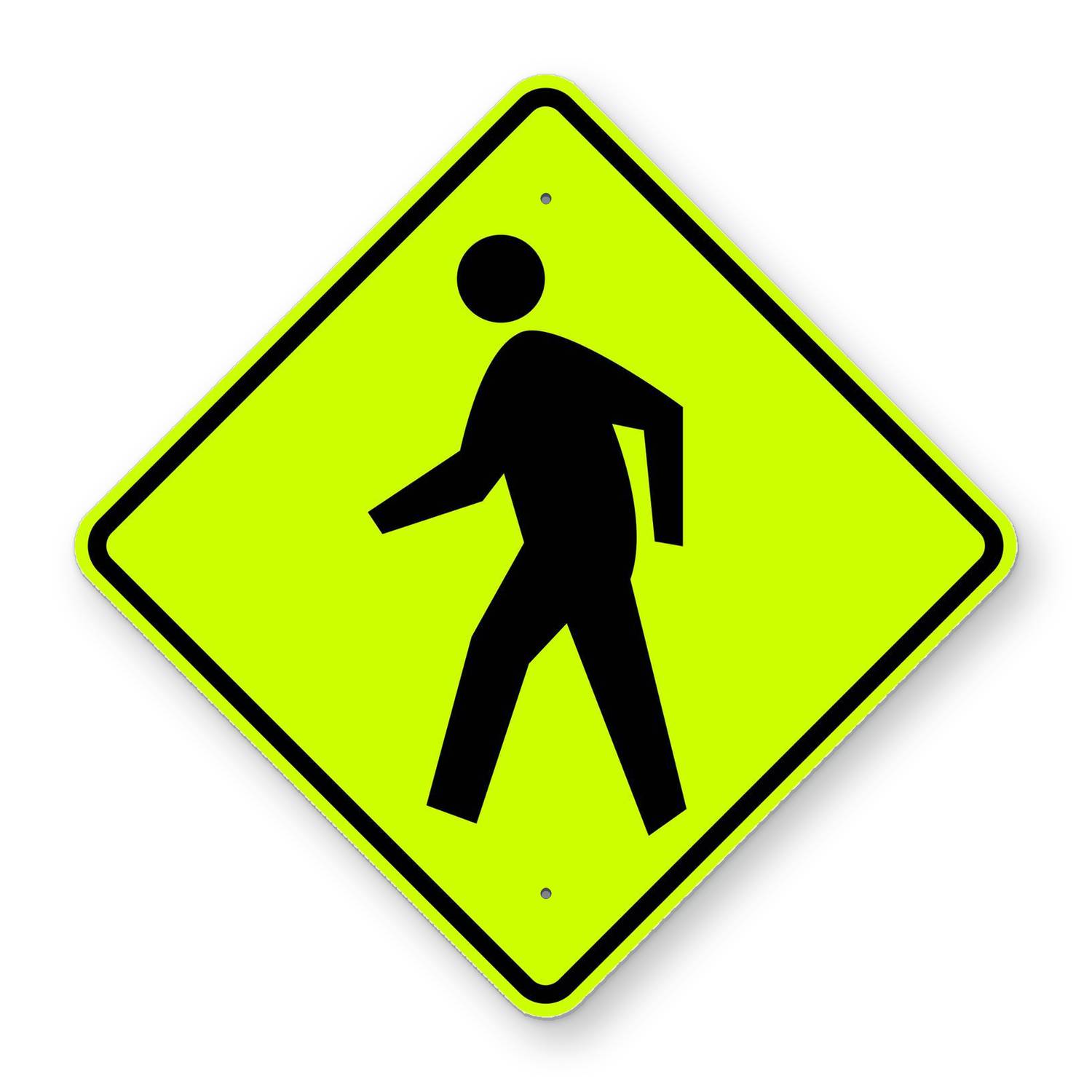
Yellow is the MUTCD warning color. A yellow sign does not give an order the way a white regulatory sign does. It tells a driver that something in the road ahead calls for attention: the road bends, another road joins, the pavement changes, animals or people cross here, or the road simply ends. Most yellow signs are diamonds. The rest are the plaques that hang under a diamond to add a distance, a direction, or an advisory speed, plus a few special shapes such as the No Passing Zone pennant and the School pentagon, which is fluorescent yellow-green rather than plain yellow.
Because yellow warns of a permanent condition, it is the color for county roads, city streets, private roads, campuses, and parks. Orange is the same shape and message for a temporary work zone, and those signs are in our Construction Signs category.
Which Yellow Sign Do You Need?
Start with what the driver will meet, then pick the sign that names it. Each row links to the sub-category with every size and left or right version.
Scroll sideways to view the full table on smaller screens.
| Condition ahead | Signs to use | MUTCD codes |
|---|---|---|
| The road bends, turns, or winds | Curve Signs, with advisory speed versions from 5 to 50 mph | W1-1, W1-2, W1-3, W1-5, W1-1a, W1-2a |
| A curve needs a recommended speed on a separate plaque | Advisory Speed Signs | W13-1P |
| Another road crosses or joins | Intersection Signs, Side Road Signs, roundabout ahead | W2-1 to W2-8 |
| A Stop or Yield sign is coming up | Stop Ahead Signs, Yield Ahead | W3-1, W3-2 |
| The speed limit drops ahead | Reduced Speed Limit Ahead and Speed Zone Ahead in Speed Limit Signs | W3-5, W3-5a |
| Two lanes become one | Merge Signs | W4-1, W4-2 |
| The pavement is the hazard | Bump, Dip, Slippery When Wet, Uneven Lanes, Fallen Rocks, Grooved Pavement in Road Warning Signs | W8-1, W8-2, W8-5, W8-11, W8-14, W8-15 |
| Railroad tracks ahead | Railroad Crossing Signs | W10-1, W10-5 |
| People or animals cross here | Pedestrian Signs, Animal Crossing Signs, Bicycle Signs, Crossing Signs | W11-1, W11-2, W11-3, W11-9, W11-10, W11-15 |
| The road ends or has no outlet | Dead End and No Outlet in Road Warning Signs | W14-1, W14-2 |
| No passing zone begins | No Passing Zone pennant | W14-3 |
| Children play nearby | Children at Play Signs | W15-1, W42-3 |
| The diamond needs a distance, arrow, or Ahead plaque | Supplemental Plaques, Distance Road Signs | W16-2P, W16-5P, W16-7P, W16-9P, W7-3aP |
Left and right versions matter. A Right Curve sign shows the road bending right, and a Side Road Right sign shows the junction on the right. Order the version that matches the road as the driver sees it, not the side you will mount the post on.
What Size Yellow Sign Do I Need?
MUTCD Table 2C-2 sets warning sign sizes by road type. A larger sign is always allowed. A smaller one is not.
- 30" x 30" is the standard diamond for two-lane conventional roads, and the size most cities, counties, and private owners order.
- 36" x 36" is the standard for multi-lane conventional roads and expressways.
- 48" x 48" is the standard for freeways and the right choice on any road posted 55 mph or more.
- Plaques follow the diamond above them. A 30" diamond takes an 18" advisory speed plaque or a 24" x 18" distance plaque. A 36" or 48" diamond takes a 24" advisory plaque or a 30" x 24" distance plaque.
- Pedestrian, school, and bicycle warning signs are the exception: the MUTCD standard for W11-2 is 30" x 30" on any conventional road, and the S1-1 school pentagon is 36" x 36".
If you are replacing a sign, measure the old one and match its code. Our product pages list every size we carry for each sign.
Which Reflective Sheeting Should You Order?
- High Intensity Prismatic (HIP) meets ASTM Type IV and the MUTCD minimum retroreflectivity for yellow warning signs. It is the standard order for city streets, county roads, and private property.
- Diamond Grade DG3 meets ASTM Type XI and returns about twice the light of HIP. Choose it for high-speed roads, unlit rural curves, and signs on the outside of a bend where headlights hit at an angle.
- Diamond Grade Fluorescent Yellow is DG3 with a fluorescent face that stays bright at dawn, dusk, and in rain. It is offered on select warning signs and is the grade many state DOTs now specify for curve and intersection warnings.
When a state or municipal spec names a sheeting grade, match it. When it does not, HIP is right for most yellow signs and DG3 is the upgrade for speed and darkness.
Where to Place a Yellow Warning Sign
A warning sign has to give the driver time to see it, read it, and react before reaching the condition. MUTCD Table 2C-4 sets the advance distance by posted speed and the type of condition. As a working rule, place the sign about 100 to 200 feet ahead on a street posted 25 to 30 mph, 350 to 550 feet ahead at 45 to 55 mph, and 700 feet or more at 65 mph. A distance plaque under the diamond lets one sign work at a longer distance. Mount the bottom of the sign at least 7 feet above the pavement where pedestrians walk and 5 feet in rural areas.
Why Buy Yellow Road Signs from RoadSigns.com
Our signs are made in the USA on .080" aluminum, the same gauge state DOTs specify, with prismatic sheeting applied to the exact MUTCD legend, border, and color layout. Every size and sheeting combination is priced on the product page, so you can order one replacement sign or a full set without waiting on a quote. Quantity pricing applies automatically when you order the same sign in multiples. We are a registered federal supplier and ship nationwide from the factory. If the sign you need is not in this category, email us and we will make it.
Yellow Road Sign FAQ
What is the difference between a yellow and an orange warning sign?
Same shape, same symbol, different lifetime. Yellow warns of a permanent condition and stays up for years. Orange is reserved for temporary traffic control and comes down when the work is done. Never use an orange sign for a permanent curve or crossing.
Do I need the advisory speed on the sign or on a separate plaque?
Either is correct. Our curve and turn signs with the speed printed in the diamond are one piece to mount. A separate W13-1P plaque lets you change the speed without replacing the diamond, and is required when the speed applies to a condition shown on a sign that has no in-face version.
Can I put a Children at Play sign on a public street?
The MUTCD does not include Children at Play, so most state and city engineers will not install it on a public road. It is widely used on private streets, in subdivisions, campgrounds, and campuses. For a public road, the Playground sign W15-1 and the pedestrian and school crossing signs are the recognized alternatives.
When should I replace a yellow sign?
When it is visibly paler than a new one in daylight, or when it no longer lights up under headlights at night. Yellow fades faster than most colors, and most agencies replace warning signs on a 10 to 12 year cycle. Inspect at night at least once a year.