
Road symbol signs communicate warnings, restrictions, and directions through recognizable graphics, helping drivers read the message with less reliance on written text. Our selection includes intersection and curve symbols, merge and lane ends warnings, pedestrian and animal crossings, Slippery When Wet, worker symbols, parking restrictions, and route arrows on .080" reflective aluminum.
-
Handicap Crossing Sign W11-9
.080" aluminum -
Deer Crossing Sign W11-3
.080" aluminum -
Chevron Alignment Sign W1-8
.080" aluminum -
Signal Ahead Warning Sign W3-3
.080" aluminum -
T Intersection Warning Sign W2-4
.080" aluminum






What Are Road Symbol Signs?
Road symbol signs use a simple picture in place of words: a leaping deer, a curved arrow, a person walking, or a red circle and slash over a turn arrow. Drivers understand a symbol in a glance, often from farther away than a line of text, and it works for visitors and drivers who do not read English. That is why the MUTCD, the federal rulebook for road signs, uses standard symbols on many warning and regulatory signs.
The color tells drivers what kind of message to expect before they even read the symbol:
- Yellow: a warning about the road ahead, such as a curve, an intersection, or a crossing.
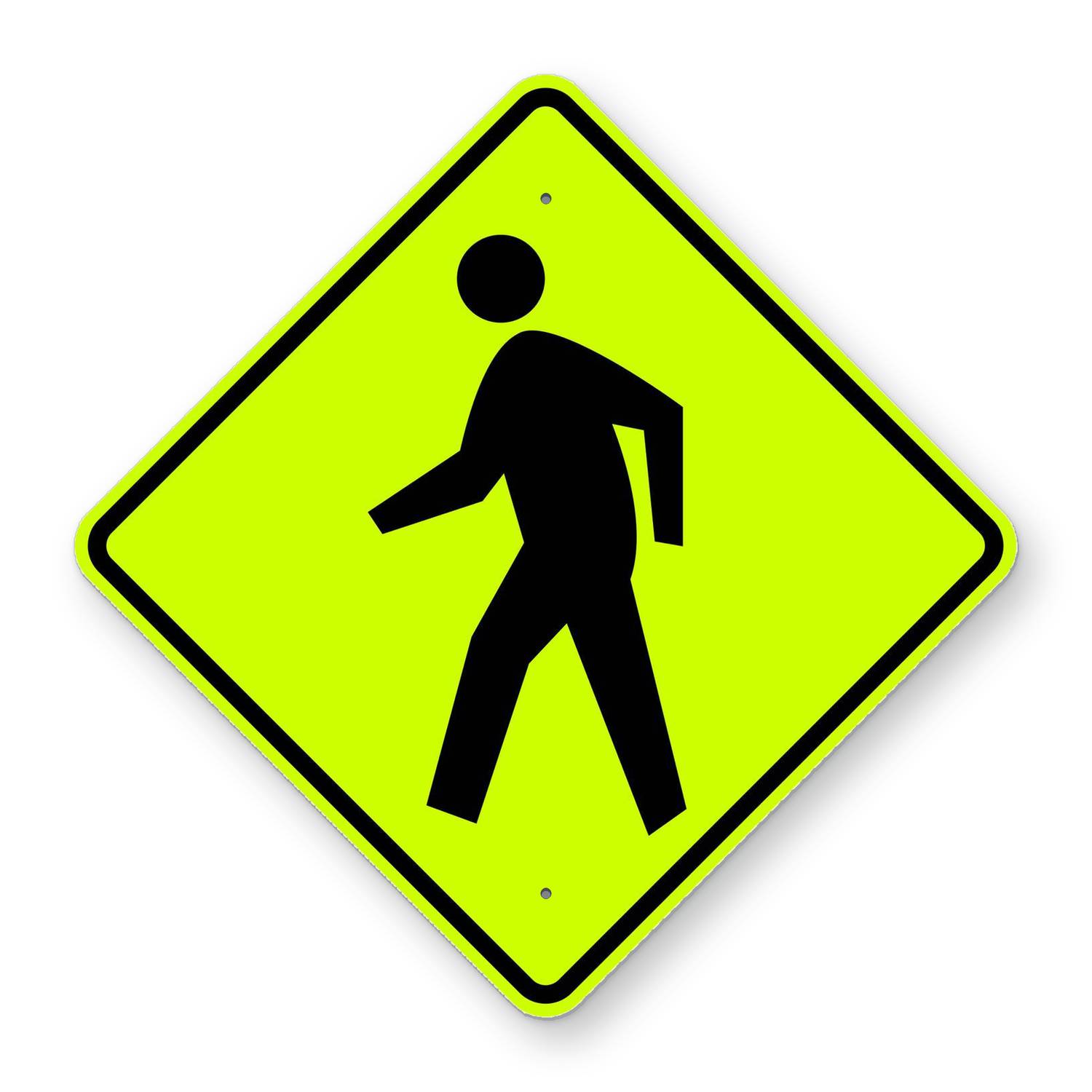
- Fluorescent yellow-green: pedestrians, bicycles, schools, and playgrounds.
- Orange: a temporary work zone.
- White with a red circle and slash: something is not allowed, such as a left turn, trucks, or bicycles.
- Blue: a service nearby, such as a hospital.
Types of Road Symbol Signs
This category brings together every symbol sign we carry, grouped below by what the sign tells drivers.
Scroll sideways to view the full table on smaller screens.
| Type | What it tells drivers | Signs in this category |
|---|---|---|
| Curves and turns | The road bends ahead, and how sharply | Turn (W1-1), Curve (W1-2), Reverse Turn (W1-3), Reverse Curve (W1-4), Winding Road (W1-5), Double Arrow (W1-7), Chevron (W1-8), multi-lane Reverse Curve (W24-1) |
| Intersections | A crossroad, side road, T, Y, or roundabout is coming up | Crossroad (W2-1), Side Road (W2-2, W2-3), T (W2-4), Y (W2-5), Circular Intersection (W2-6), Offset Side Roads (W2-7), Double Side Roads (W2-8) |
| Stop and yield ahead | A stop or yield sign is ahead that drivers may not see in time | Stop Ahead (W3-1), Yield Ahead (W3-2) |
| Merges and lane ends | Traffic is joining or a lane is ending | Merge (W4-1), Lane Reduction (W4-2), Double Lane Reduction (W4-2D) |
| Crossings | People, bicycles, animals, or trucks may enter the road | Pedestrian (W11-2), Bicycle (W11-1), Bicycle and Pedestrian (W11-15), Handicap (W11-9), Truck (W11-10), Deer (W11-3), Bear, Sheep, Bighorn Sheep, Donkey, and Elk (W11-16 to W11-20) |
| Schools and playgrounds | Children may be nearby or crossing | School (S1-1), School Bus Stop Ahead (S3-1), Playground (W15-1) |
| Road and railroad conditions | The surface or crossing ahead needs extra care | Slippery When Wet (W8-5), Bicycle Slippery When Wet (W8-10), Railroad Crossing Advance Warning (W10-1), Low Ground Clearance (W10-5) |
| Work zones | Workers or a flagger are on or near the road | Workers (W21-1), Flagger (W20-7), and orange versions of the curve, merge, Slippery When Wet, Stop Ahead, and Yield Ahead signs |
| Not allowed | A turn, vehicle, or activity is prohibited | No Right Turn (R3-1), No Left Turn (R3-2), No U-Turn (R3-4), No U-Turn and No Left Turn (R3-18), No Straight Through (R3-27), No Trucks (R5-2), No Bicycles (R5-6), No Parking (R8-3), No Pedestrian Crossing (R9-3), No Skaters (R9-13), No ATVs (R9-16) |
| Services and directions | Where a service is, or which way to go | Hospital (D9-2), Accessibility (D9-6), Airport (I3-5), route arrow plaques (M5, M6), arrow plaques for warning signs (W16-5P, W16-6P, W16-7P) |
How to Choose the Right Road Symbol Sign
1. Match the symbol to what drivers will meet
Stand where the sign will go and look down the road the way a driver would. The symbol should show the hazard or rule exactly as it appears ahead. A few common choices:
- Turn or curve? Use a Turn sign (W1-1) when the safe speed through the bend is 30 mph or less, and a Curve sign (W1-2) when it is higher. Reverse Turn (W1-3) and Reverse Curve (W1-4) show two bends in opposite directions close together, and Winding Road (W1-5) covers three or more.
- Which intersection? A Crossroad (W2-1) has roads joining from both sides, a Side Road (W2-2) has one road joining from one side, and a T (W2-4) means your road ends ahead.
- Which crossing? Pick the symbol for who actually crosses there: people, bicycles, deer, or trucks. A specific symbol gets more attention than a general one.
2. Choose left or right
Many symbols come in left and right versions, shown by the L or R at the end of the code. The symbol must point the same way the road goes, so a curve to the right takes the R version.
3. Pick the size
A bigger sign can be read from farther away. The MUTCD sets the size for each sign by type of road. For yellow diamond warning signs:
- 24" x 24": the MUTCD minimum, for low-speed and low-volume roads.
- 30" x 30": the usual size for many warning signs on two-lane roads.
- 36" x 36": for multi-lane roads, expressways, and higher speeds.
- 48" x 48": for freeways, and anywhere a sign needs to stand out more.
- 18" x 18": offered on some signs for parking lots, campuses, and private drives. It is below the MUTCD size for public roads.
Square signs such as No Left Turn start at 24" x 24", and chevrons and arrow plaques have their own sizes, listed on each product page. Our road sign size guide shows which size fits your road and speed.
4. Choose the reflective sheeting
- High Intensity Prismatic (HIP): bright at night and the right choice for most city, county, and private roads. Backed by a 10-year sheeting warranty.
- Diamond Grade DG3: our brightest sheeting, for high-speed roads, dark rural roads, and signs seen at a wide angle. Backed by a 12-year sheeting warranty.
- DG3 fluorescent colors: Fluorescent Yellow on warning signs, Fluorescent Yellow-Green on pedestrian, school, and bicycle signs, and Fluorescent Orange on work zone signs. They stand out more in daylight, at dawn and dusk, and in rain or fog.
Where to Install a Road Symbol Sign
Warning signs go before the hazard, not at it, so drivers have time to see the symbol, understand it, and slow down. The faster the road, the farther ahead the sign goes: roughly 100 feet ahead on a slow street and several hundred feet ahead on a highway. Signs such as No Left Turn go at the spot where the rule applies.
Mount the sign on the right side of the road, with the bottom edge at least 7 feet above the edge of the pavement in towns and where people walk, and at least 5 feet in rural areas. Add an arrow or distance plaque below the sign when it helps drivers find the hazard. Our sign posts come with or without mounting hardware.
Why Buy Road Symbol Signs From RoadSigns.com?
The Official Symbols, Made in the USA
Our symbol signs follow the official MUTCD designs, so the deer, the arrows, and the borders have the same shapes and proportions as the signs you see on the road. Each one is made in the USA on .080" rust-proof aluminum, the gauge state DOTs specify, with 3M reflective sheeting.
Clear Prices on Every Size and Sheeting
Every size and sheeting option is priced on the product page, so you can order one sign or a full road's worth without waiting on a quote. Order 2 or more of the same sign and volume pricing applies automatically in your cart: 5% off 2-4 signs, 10% off 5-9, 15% off 10-24, and 20% off 25-49.
Quick Shipping, Free Over $200
Signs marked Quick Ship usually ship in 1 business day, and the rest usually ship in about 5 business days. Use the Quick Ship filter on this page to see them. Orders over $200 ship free to the lower 48 states when every item is a sign smaller than 36" x 36".
Help Before You Order
Not sure which symbol, size, or sheeting your road needs, or looking for a symbol you do not see here? Call (888) 495-7623 or send us a message with the sign code or a photo of the spot, and we will help you choose.
Ordering for an Agency, School, or Contractor?
RoadSigns.com is a registered federal supplier on SAM.gov, and we accept purchase orders from government agencies, the military, and schools. For 50 or more signs or a full sign list, send the sign codes, sizes, quantities, delivery ZIP code, and needed-by date through our quote request page.
Road Symbol Sign FAQ
What do codes like W11-2 mean?
The letter is the sign family in the MUTCD: W is a warning sign, R is regulatory (a rule drivers must follow), S is a school sign, D is a guide or service sign, and M is a route marker plaque. The number is the group within that family, so all W11 signs are crossing signs. An L or R at the end means left or right, and a P means a plaque that mounts under another sign.
Should I choose a symbol sign or a word sign?
Where both exist, such as the Stop Ahead symbol and the STOP AHEAD word sign, the symbol is usually the better choice because it reads faster and works for every driver. A word sign can be clearer for a local rule on private property. If you need your own wording, you can design it on our custom signs page.
Can I use these signs on private property?
Yes. Parking lots, private roads, campuses, and job sites use the same symbols because drivers already know them. If your private road is open to public travel, the MUTCD applies there too, so a standard symbol sign is the safe choice.
Should a pedestrian or school sign be yellow or fluorescent yellow-green?
Both are allowed. Many cities and school districts choose fluorescent yellow-green because it stands out more in daylight. Whichever you pick, use the same color for all the pedestrian, school, and bicycle signs in one area so drivers are not confused.
Can I put a sign on a public road myself?
No. Signs on public roads are placed by the road owner, usually the city, county, or state. If a spot near you needs a sign, ask that agency first. Contractors and agencies can order directly from us for their own projects.